
The Wrong Cleaner Ruined My Countertop — What Now?
A supermarket spray and an abrasive sponge can dull a marble or limestone counter in one afternoon. The good news: the damage is shallow, which means it is fixable — without replacement.
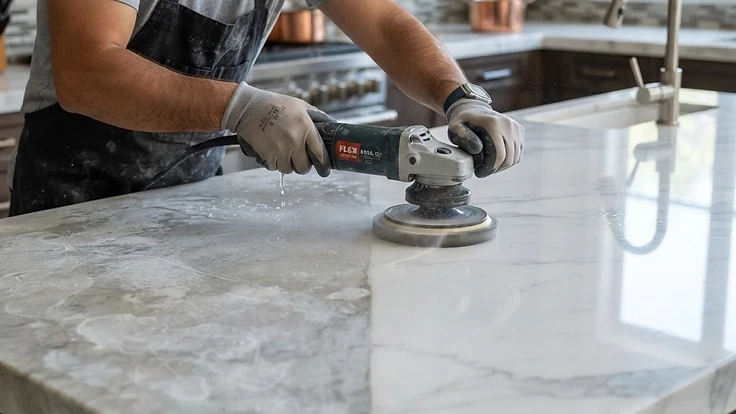
It is one of the most common calls we get, and it almost always starts the same way: "The house was cleaned, the counter looked cloudy, and now there are these dull white patches that won't wipe off." The story underneath is usually the same too — a general-purpose spray cleaner (nearly all are acidic or alkaline) used on marble, travertine or limestone, or an abrasive scrub pad worked over the surface to "get the marks off." One afternoon of the wrong chemistry has undone years of finish.
What actually happened to the stone
Marble, travertine and limestone are calcite stones — they react with acids. Acidic cleaners dissolve a microscopic layer of the surface itself, leaving a dull etch mark where the polish used to be. Strongly alkaline degreasers do a slower version of the same damage. And abrasive pads scratch the soft surface into an overall haze. Crucially, none of this is a substance sitting on the counter. The damage is to the stone itself, which is why no cleaner you apply on top will ever bring the shine back — scrubbing harder just makes it worse.
We see two patterns constantly: a hazy, shadowed patch where someone sprayed and wiped the same area repeatedly, and a "mystery" of small dull rings that map exactly to where glasses and mugs get set down. Both are chemical damage, and both are shallower than they look.
Why it is fixable
The saving grace of etching is depth: the damage is a fraction of a millimetre into the stone. Honing removes the damaged layer with progressively finer diamond abrasives, flattening the surface to an even, consistent finish; polishing then works up through finer grits until the depth and gloss return. The etch marks are not filled or hidden — the stone layer carrying the damage is removed entirely, and what remains is the original material, refinished. For a bathroom vanity the process takes hours; a full kitchen counter is a day.
You can also choose the finish you come back to: a high gloss, a satin honed finish (increasingly popular in kitchens because it shows less), or a match to the surrounding stone.
The routine that keeps it from happening again
- Only pH-neutral stone cleaner, or plain warm water with a drop of mild dish soap, touches the counter.
- No supermarket sprays, no vinegar, no citrus or ammonia products — check the label; "granite safe" does not always mean marble safe.
- Coasters under glasses, trivets under anything hot, and a cutting board for anything acidic — lemon, tomato, wine, coffee.
- Blot spills rather than wipe them; wiping spreads the acid while it is reacting.
- Reseal on schedule — sealing protects against stains, buying you minutes to blot; only avoiding acids protects against etching.
If your counter has gone dull in patches and the cleaning products under the sink include anything other than pH-neutral, the counter is telling you what happened. A free assessment shows exactly how deep the damage is and what the stone will look like restored — almost always for a small fraction of what anyone fears replacement would cost.
Want this handled professionally?
Our Bay Area technicians clean, seal and restore tile and stone of every kind — with free, no-obligation quotes.