
Travertine Pool Decks and Patios: Bringing Stone Back Around Bay Area Pools
Chlorine, splash-out and constant moisture dull and darken travertine pool decks faster than any other stone surface in a Bay Area home. Here is why it happens — and how the stone comes back without replacement.
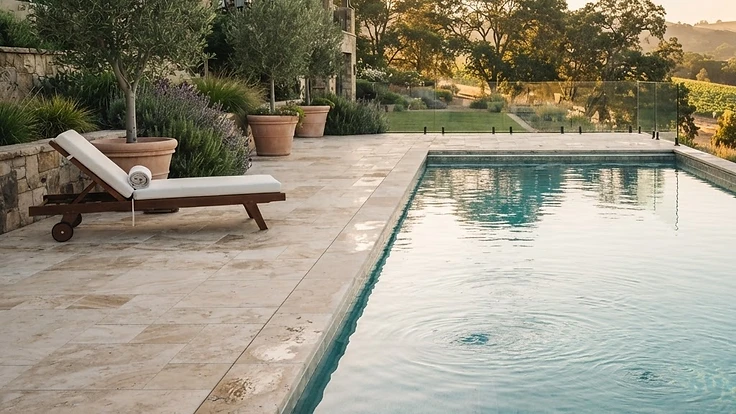
A travertine pool deck is one of the best-looking surfaces a Bay Area home can have: warm, natural, cool underfoot on a hot afternoon. It is also the hardest-working stone on the property. Between the water itself, pool chemistry, splash-out, sunscreen and feet, travertine around a pool lives in a constant cycle of wet and dry that dulls it faster than anything indoors. The good news, and it is almost always good news, is that the stone has not failed — the finish and the sealer have, and both are renewable.
Why pool-area travertine goes dull and dark
- Pool chemistry and splash-out. Chlorinated or salt-treated water is not neutral. Repeated splash-out onto the deck leaves mineral and salt residue behind as it evaporates, and over seasons that film dulls the surface and works into the pores.
- Hard-water and efflorescence. Our water carries calcium, and water migrating up through the deck from damp substrate leaves the white, powdery bloom called efflorescence — especially at the coping and along low spots where water pools.
- Sun and moisture cycling. Daily wet-dry cycles with strong Bay Area sun break down old topical sealers until they go patchy, which is what usually reads as "the stone looks tired."
- Sunscreen, algae and organics. Sunscreen lotions, leaf tannins and, in shaded or slow-drying areas, algae all stain the surface and joints — and algae on a pool deck is a genuine slip hazard.
What restoration actually involves
It is the same diamond-refinishing approach we use on interior stone, scaled to an outdoor surface:
- Deep cleaning. Heated extraction plus a controlled cleaning pass lifts the mineral film, algae, organics and dead sealer out of the stone and the joints — not just off the top.
- Honing and polishing. Where the surface has dulled or scuffed, progressively finer diamond abrasives flatten it back to an even finish, matching or refreshing the original look.
- Efflorescence treatment. Mineral bloom is neutralised at the source; persistent areas may need joint attention so water stops feeding it.
- Sealing. A penetrating, outdoor-rated sealer closes the pores so water, salt and stains sit on top. On pool decks we often favour a natural or low-sheen finish — it hides water spots better than a high gloss and keeps the stone looking natural rather than coated.
Timing and maintenance
Pool decks are best restored when they can dry: the dry season is ideal, giving the sealer a proper cure window before winter rain. After that, the routine that keeps a deck beautiful is simple — rinse with fresh water occasionally to clear splash-out and salt, keep the joints topped up so water does not channel underneath, and reseal every one to two years, closer to yearly near the coast.
If your pool deck has gone flat, grey or spotty, it is very likely one restoration away from the warm, natural surface you chose — and it can usually be done without lifting a single paver or disturbing the pool. A free assessment will show you exactly what is residue, what is growth, and what the stone will look like restored.
Want this handled professionally?
Our Bay Area technicians clean, seal and restore tile and stone of every kind — with free, no-obligation quotes.