
Hard Water, Soap Scum and Etch Marks: Restoring Marble and Travertine Showers in Bay Area Bathrooms
Bay Area water leaves calcium, soap scum and dull etch marks on polished stone showers faster than almost anywhere else. Here is what is actually damaging your marble or travertine shower — and how it comes back to full polish without retiling.
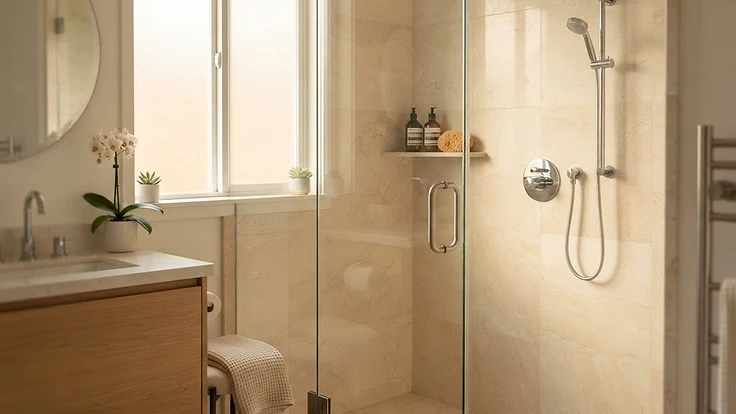
If your marble or travertine shower has gone dull, cloudy or spotted, the Bay Area's water is a big part of the story. From the East Bay to the Peninsula, our municipal water carries meaningful mineral content — and every shower sprays it onto polished stone, day after day, year after year. The result is the familiar drift: a shower that started glossy and bright slowly turns hazy, then chalky, then looks worn out long before the stone itself is actually damaged. Almost none of it is wear. It is chemistry, and it is reversible.
Three things are happening to the stone at once
Understanding which one you are looking at determines the fix, so it is worth separating them:
- Hard-water deposits. Calcium and magnesium in the water land on the stone and dry there as a pale, chalky film — especially on the walls where spray hits directly and on the floor where water sits. Left long enough it builds into visible scale that feels rough and blocks the polish underneath. This sits on top of the stone; it has not damaged the stone yet.
- Soap scum. Bar soap and hard water react to form a waxy, grey film that clings to grout lines and the lower walls. It is sticky, it holds onto body oils and mineral scale, and household cleaners spread it more than they remove it.
- Etching. This is the one that actually changes the stone. Shampoos, body washes, razors and even some "natural" cleaners are acidic. Acid reacts with calcite stones — marble, travertine, limestone — dissolving a microscopic layer of the surface and leaving a dull, lighter-coloured mark where the polish used to be. The ring a shampoo bottle leaves overnight is a classic etch mark, not a stain.
Why daily cleaning does not reverse it
The films above are not sitting loosely on the surface; they are bonded to it. Hard-water scale chemically keys onto polished calcite, and soap scum bakes on a little more with every hot shower. Standard bathroom sprays — even the ones labelled "soap scum remover" — are usually acidic, which means they attack the stone underneath while loosening the scum on top. Abrasive scrub pads do the same with scratches instead of chemistry. So the shower that gets cleaned most often is often the one that has gone dullest, because the cleaning itself is quietly etching the polished face.
How restoration brings it back
Professional shower restoration is not a coating or a cover-up; it is the same diamond-refinishing process used on stone floors, scaled to vertical surfaces:
- Deep extraction. Heated, low-moisture extraction lifts soap scum, body oils and the top layer of mineral scale out of the pores of the stone and the grout — not smearing it across the wall.
- Descaling. Remaining calcium deposits are dissolved with a controlled, stone-safe process and fully neutralised, so the scale comes off without touching the stone beneath it.
- Honing. Where etching has dulled the surface, progressively finer diamond abrasives remove the damaged micro-layer and flatten the stone back to an even, consistent finish.
- Polishing. Finer grits bring the stone back up through a satin honed finish to a full mirror polish, matching the original sheen — or letting you choose a softer, lower-maintenance finish if that suits the bathroom better.
- Sealing. A penetrating sealer closes the pores so the next round of water and soap sits on top instead of soaking in, buying you far more time between deep cleans.
Grout gets the same attention: deeply soiled joints are extracted and can be colour-sealed so they stay bright and non-porous — the single biggest visual lift in most shower restorations.
Keeping it that way
The maintenance routine that protects a restored shower is simple, and it is the opposite of how most people clean:
- Squeegee the walls and glass after every shower — it removes the water before the minerals have a chance to dry, which is the single most effective thing you can do.
- Use a pH-neutral stone cleaner, or plain warm water, only. No supermarket bathroom sprays, no vinegar, no lemon.
- Switch to a liquid body wash rather than bar soap to cut soap scum dramatically.
- Keep shampoo and cleanser bottles off the stone surface, or sit them on a tray, so they cannot etch the shelf or floor beneath them.
- Reseal the stone on a regular cadence — yearly for a heavily used shower — so water and product never reach the open pores again.
A marble or travertine shower that looks tired is almost never a retiling job. It is a surface that has been slowly coated and lightly etched, and it comes back to the finish it had the day it was installed — usually in a single day of work, without touching the plumbing or the glass. A free assessment will show you exactly what is scale, what is scum, what is etching, and what the stone will look like restored.
Want this handled professionally?
Our Bay Area technicians clean, seal and restore tile and stone of every kind — with free, no-obligation quotes.